
Definition: What is delivery capability?
In logistics, the delivery capability metric indicates the extent to which a company can guarantee that it will be able to deliver products on demand at any time. Expressed as a percentage, this metric indicates the extent to which customer satisfaction is met. Delivery capability can be influenced, for example, by fluctuating order intake or poor communication. The latter occurs when delivery dates are committed to without prior consultation with the warehouse or production department.
Difference Between Delivery Capability and Delivery Readiness
The term is often used synonymously with “delivery readiness,” but readiness presupposes that the capability already exists. If only delivery capability is present, delivery readiness may be limited by other factors, such as the current order volume or business hours.
Importance of Delivery Capability
The delivery capability metric is highly relevant for companies because high delivery capability increases customer satisfaction. On-time delivery is essential because customers want to receive their goods as quickly as possible. If delivery deadlines or requested dates cannot be met, this has a negative impact: Customers switch to competitors and sometimes leave negative reviews. Furthermore, the company must ensure that inventory levels are neither too high (excessive capital tied up) nor too low (out-of-stock situations)—keyword: inventory management. Delivery capability is therefore also a key indicator of a company’s profitability. Supply chains are extremely vulnerable, especially in the face of unforeseen events such as the COVID-19 pandemic. Companies must therefore take measures to make their delivery capability—and thus their entire supply chains—resilient and stable.
Which parts of the supply chain have the greatest impact on delivery capability?
Demand Planning
Ensuring high delivery capability depends on how accurately future demand is known for various time periods. Professional demand planning provides the necessary transparency for informed decisions. When demand is accurately forecasted—including seasonal patterns, promotional effects, or shifts in trends—purchasing, production, and logistics can respond in a timely manner. Incorrect assumptions or relying on gut feelings can lead to out-of-stock situations or excess inventory, which ties up capital.
Inventory Management
Inventory management ensures that the right items are in the right quantities at the right location. This involves topics such as safety stock, minimum and reorder levels, ABC/XYZ analyses, and inventory accuracy. Typical obstacles to delivery capability include incorrect parameters, “forgotten” slow-moving items, undetected inventory errors, or inventory that is high—but in the wrong location. With specialized inventory management software , companies can optimally control their inventory.
Forecasting
Forecasting is the operational translation of “demand” and “inventory” into concrete replenishment decisions. In other words: When should orders be placed? How much? From where to where? Especially with dynamic demand, the forecasting process makes the difference between stable delivery capability and constantly playing catch-up. Those who operate according to rigid rules or with overly broad ordering cycles create gaps or trigger unnecessary rush orders. Flexible, data-driven planning keeps the flow moving—even when the market is volatile.
Supplier Performance
Even with perfect plans and inventory levels, delivery capability is of little use if supplier deliveries are unreliable. Supplier performance describes how punctually, completely, and to the right quality standards deliveries are made—and how stable delivery times really are. Fluctuating lead times, last-minute quantity changes, or quality defects directly impact availability. This becomes particularly critical in single-sourcing scenarios or global supply chains with long transport routes. The more closely suppliers are integrated into planning and communication, the more robust supply capability remains.
How is delivery capability calculated?
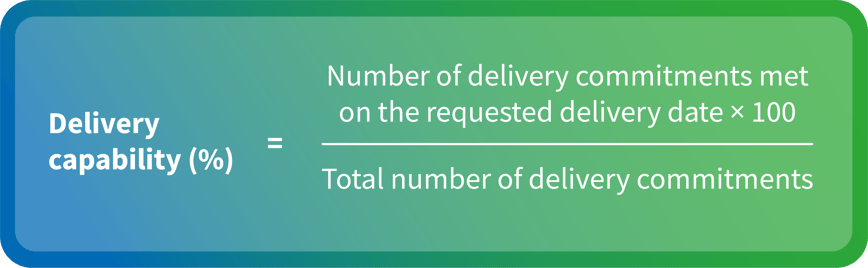
Delivery capability indicates the percentage of cases in which the promised delivery date matches the actual delivery date. It is calculated using the following formula:
Which metrics reliably measure delivery capability?
Service Level / Fill Rate
The service level (often measured as the fill rate) answers the key question: How much of the demand can be fulfilled directly from inventory? A fill rate of 95%, for example, means that 95 out of 100 requested units are immediately available. This metric is extremely practical because it directly reflects the customer experience. It is important, however, to clearly define the level at which it is measured (item, category, location, customer)—otherwise, you’re comparing apples to oranges.
OTIF (On Time In Full)
OTIF goes a step further and measures whether a shipment arrives at the customer on time and in full . “On Time” means: within the agreed-upon time window. “In Full” means: without shortages or partial shipments. This makes OTIF a true end-to-end indicator of delivery capability, because it takes into account not only inventory but also transportation, warehouse processes, and suppliers. Especially in the B2B environment or for store deliveries, OTIF is often the gold standard.
Out-of-Stock Rate / Backorder Rate
These metrics show the other side of the coin: How often is an item unavailable (out of stock), or how much demand needs to be fulfilled through backorders? They are particularly helpful for identifying pain points: Which items are causing stockouts? Which locations are regularly undersupplied? And how does this affect sales or customer satisfaction? Out-of-stock rates also serve as a strong early warning signal when forecasting, inventory, or scheduling fall out of sync.