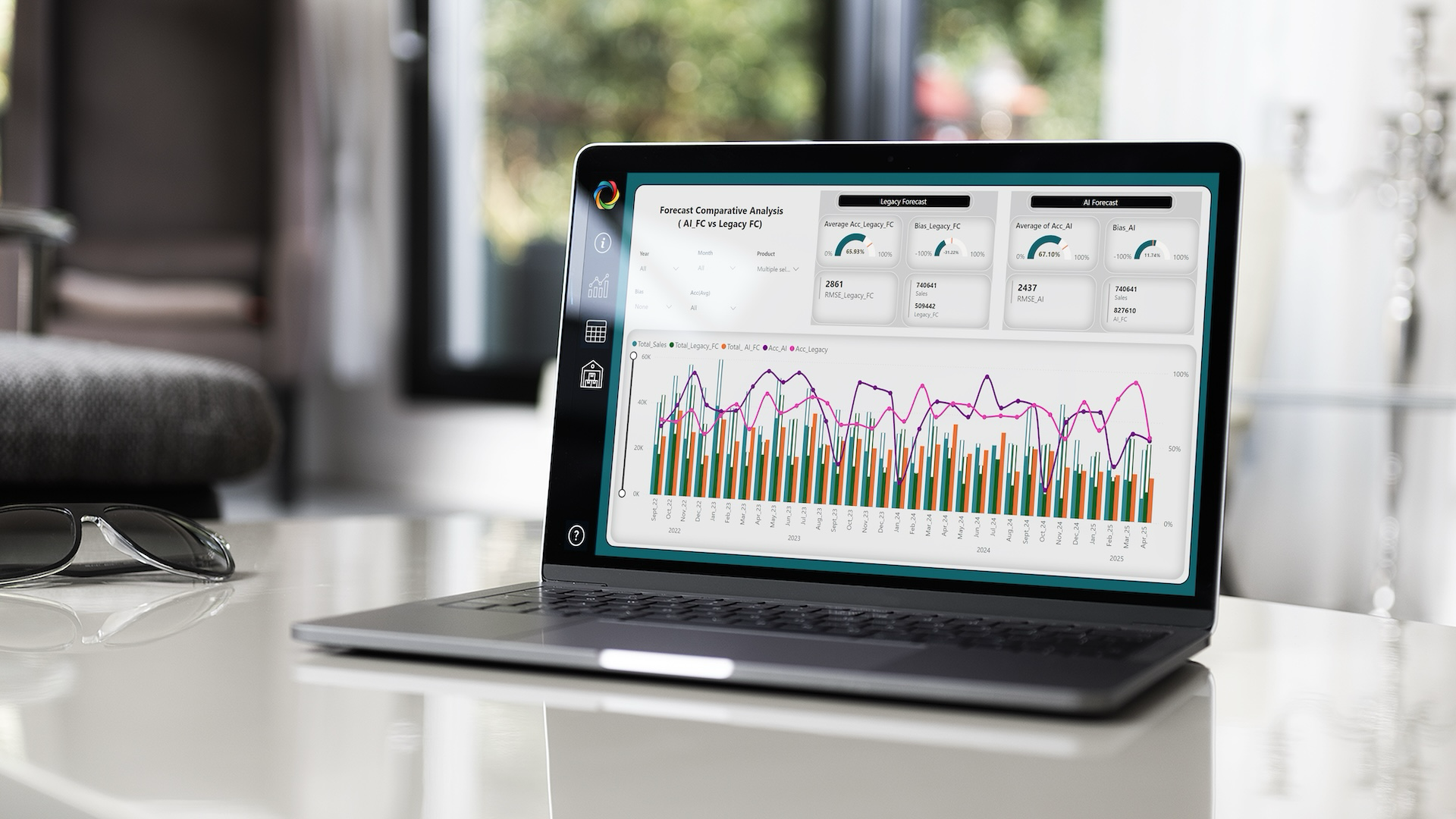
In a market environment characterized by volatile demand and fragile supply chains, traditional, manual inventory management is increasingly reaching its limits. This article examines how companies can strike a balance between maximizing delivery capacity and minimizing capital tied up in inventory through the strategic use of artificial intelligence (AI). From rule-based systems to cutting-edge Agentic AI, the article demonstrates how technological evolution is revolutionizing inventory planning. Real-world projects demonstrate that, depending on the initial situation, AI can reduce inventory by up to 30% and manual planning effort by up to 75%.
In times of global uncertainty and mounting economic pressure, companies face the challenge of efficiently managing their inventory without jeopardizing delivery capacity. Artificial intelligence has evolved from a buzzword to a critical competitive factor. But not all AI is created equal—the technological evolution ranges from simple, rule-based systems to autonomous agents that independently handle complex decision-making processes. A look at the stages of development shows how companies today can secure their liquidity and massively increase efficiency in inventory planning. This is not about replacing humans, but rather about creating a symbiotic relationship that reduces inventory while simultaneously maximizing delivery capability.
Companies today operate in an environment characterized by disrupted supply chains, volatile markets, and intense cost pressure. In inventory management, value creation in this context means one thing above all else: keeping capital tied up as low as possible while ensuring maximum delivery capability. Companies that operate inefficiently in this area risk competitive disadvantages due to excessively high operating costs or stockouts. AI serves as a valuable partner in this balancing act by providing precise forecasts and automating routine tasks. The real-world results speak for themselves: AI-supported forecasts can reduce inventory levels by up to 30% while maintaining the same level of availability.
The limits of traditional demand planning
Traditional demand planning reaches its limits where human capacity ends. A planner managing thousands of items can hardly calculate the optimal order quantity for each item on a daily basis while taking seasonality, trends, and promotional campaigns into account. Practical experience shows that manual planning is often reactive. The result is “gut-feel” safety margins that may ease one’s conscience but fill warehouses and tie up liquidity unnecessarily.
AI-powered systems address this very issue. They do not function as a black box, but rather as a high-performance assistant that analyzes vast amounts of data in real time. The focus shifts away from pure data management toward strategic control.
The four stages of AI evolution in inventory management
To fully harness the potential of AI, an understanding of the various stages of technological development is necessary. REMIRA, an expert in intelligent software solutions for over 30 years—particularly in the areas of sales forecasting and inventory management—divides this evolution into four key areas:
Rule-based static AI
This is the classic form, in which software makes decisions based on static, unchanging parameters. Simple mean value calculations are often used here. The AI operates within rigid rules specified by employees.
Dynamic rule-based AI
At this stage, while the company still sets the boundaries of the rules, the AI independently determines the optimal parameters within that framework. Such systems are already capable of recognizing seasonality and changes in demand patterns.
Multi-time series AI
Here, the technology moves beyond traditional forecasting methods and enters the realm of machine learning. It no longer considers only individual time series but incorporates a multitude of external factors into the calculation, resulting in significantly higher forecast accuracy.
Agentic AI
The highest stage of evolution is marked by the use of autonomous agents. These small programs mimic the behavior of employees completely autonomously. An agent is triggered by an event and independently executes a defined process to deliver a valid result—without manual intervention.
Measurable business impacts and process optimization
The use of intelligent systems significantly reduces the workload on employees. In practice, automation can cut the manual effort required for inventory planning by up to 75%. This frees up valuable time for skilled staff to focus on strategic tasks. Another key benefit is a 30–50% reduction in out-of-stock situations. Improved product availability combined with optimized inventory levels frees up working capital, which directly improves the company’s liquidity.
AI truly demonstrates its full potential, especially in companies with multiple locations or warehouse tiers: Cross-location optimization can further reduce inventory levels by 10–15%. AI dynamically responds to changes in supply chains or demand and continuously adjusts parameters to current market conditions.
The path to AI-powered inventory management
Despite the clear advantages, according to a recent REMIRA survey of customers and prospects, around 64% of companies still do not use AI in their inventory management. The reasons? Skepticism or a lack of internal expertise. But getting started doesn’t have to be complicated. It is important to assess your current situation and find the right AI solution for your specific needs. Whether it’s automating routines or precise demand planning—AI is no longer a “nice-to-have,” but rather the foundation for a resilient and value-adding supply chain.
Conclusion: course has been set for the autonomous supply chain
An analysis of the stages of technological development makes it clear: AI in inventory management is no longer a futuristic experiment, but a proven tool with an immediate impact on the bottom line. The key advantage lies in scalability and precision: While human planners are inevitably forced to prioritize amid a flood of data and items, AI ensures seamless optimization down to the item level—around the clock.
Companies should view the transition to AI-supported planning not as a mere IT project, but as a strategic realignment. The key point here is that humans are not being replaced, but rather freed up. By automating routine decisions (management by exception), the planner assumes the role of a strategist who manages exceptional situations and proactively shapes the supply chain.
Given that over 60% of companies are still failing to tap into this efficiency potential, there is currently a valuable opportunity to differentiate themselves from the competition. Those who take the step today from rigid rules to intelligent, agent-based systems not only secure liquidity through optimized inventory levels but also build the resilience needed to meet the challenges of tomorrow’s global markets. The technology is ready—it’s up to decision-makers to make it their partner.
If you’d like to learn more about our AI-powered inventory management solution, we’d be happy to help.