Software for AI sales forecasting

AI sales forecasting software uses artificial intelligence to predict future sales and consumption. This ensures that customer demand is always fully met. At the same time, it helps avoid tied-up capital, depreciation, wasted storage space, and spoilage of goods.

Tablet mit Diagrammen für Absatzprognosen und Forecasting

What role does AI sales forecasting play in a business?

AI-powered forecasting software helps companies better assess customer demand. To remain competitive in a highly competitive market and operate efficiently, companies must tailor their offerings to meet demand optimally. Thanks to precise AI sales forecasts, companies gain data-driven and objective insights and can make strategic decisions based on scientific methods.

AI-powered sales forecasts are used to determine market potential, projected sales, and the correct order quantities. Accurate forecasts play a key role in simplifying product planning and enabling more sustainable production. Prior to a product launch, a sales forecast can be used to assess demand for the new product and thus prevent a poor market entry if necessary.

REMIRA software for AI-powered sales forecasting supports you in all phases of the product lifecycle with precise forecasting and sales planning—even in fast-paced industries. This allows you to increase your planning accuracy, improve your procurement process, and reduce excess inventory.

Two colleagues discuss sales forecasts on the PC

Artificial intelligence in sales forecasting

Having the right quantities in the right place at the right time is the cornerstone of optimal inventory management. However, this is only possible with reliable forecasts of sales and consumption. Short-term changes pose a problem because production and delivery are, overall, a lengthy process. Accurate sales forecasts are particularly crucial for perishable products or fashion collections. To ensure the highest possible accuracy in planning, more and more companies are turning to artificial intelligence to identify sales, opportunities, and risks early on and plan accordingly.

Reliable forecasts through predictive analytics are a decisive competitive advantage

Today, the flow of goods and materials depends on numerous static and dynamic factors as well as the specific business model. The REMIRA software for AI sales forecasting takes key factors into account and automatically generates an accurate sales forecast using artificial intelligence and sophisticated algorithms. This forms the critical foundation for planning across the entire company. This means that not only replenishment but also other departments such as purchasing or sales benefit from reliable figures. The result is reliable sales forecasts, optimal order quantities at the right time across all warehouses and stores, proper workforce planning, and much more. This allows management to rely on the best possible sales forecasts and make the right strategic decisions for the company.

Geschäftsmann nutzt Laptop und Tablet, um Marktdaten und Absatzprognosen zu analysieren
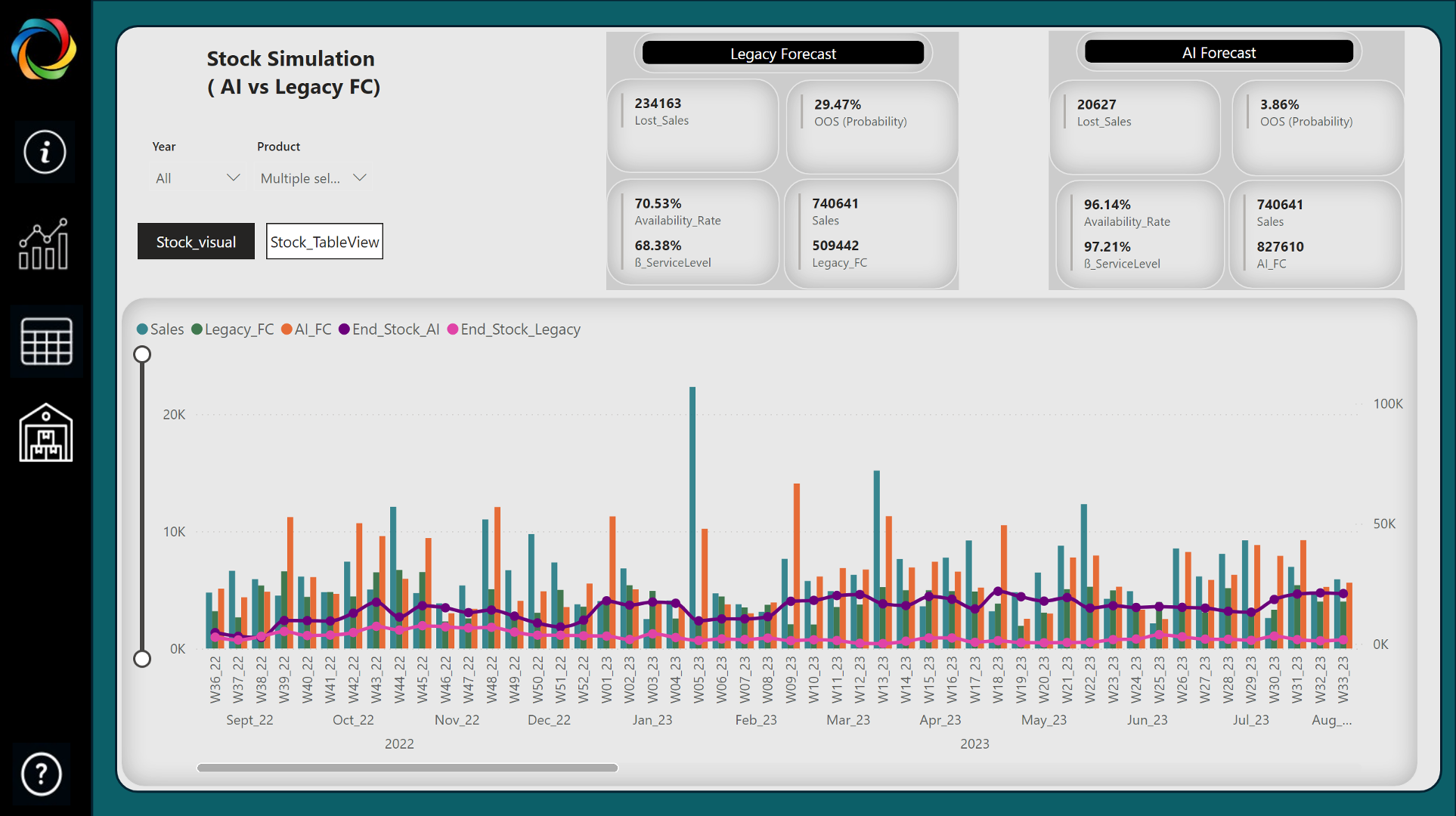
BI Screenshot Stock Simulation

Identify future sales at an early stage

The REMIRA software solution for AI sales forecasting helps companies increase the success of their products and optimize planning as well as the entire procurement process. Using artificial intelligence, sales forecasts can be calculated with great accuracy—even for short-lived product cycles. This allows market opportunities and risks to be calculated, giving companies a competitive advantage.

What are the advantages of sales forecasting software?

The goal of using AI sales forecasting software is to achieve a perfect balance between supply and demand. The REMIRA software helps users make the most of existing market potential and resources. The solution uses statistical forecasting methods and artificial intelligence to determine optimal sales forecasts and order recommendations.


What are the requirements for implementing AI sales forecasting software?

An existing database is essential, which is typically provided by an ERP or merchandise management system. REMIRA solutions integrate seamlessly with the existing ERP system. This is achieved using REMIRA’s connectivity tools, which enable a straightforward connection to the respective ERP system via an interface. If, for example, SAP ERP is used, this can be implemented without the need for additional SAP partners.

The REMIRA software is also available as a cloud version or a hybrid solution. Feel free to contact us for more information.

SAP_Picture 1 - source - Gorodenkoff - stock.adobe.com-1

FAQ: Software for AI sales forecasting

AI-powered sales forecasting software is a specialized tool that uses artificial intelligence to accurately predict future sales figures based on large amounts of data and by taking all internal and external factors into account. External factors include, for example, seasonal fluctuations, current market trends, weather data, or promotional campaigns. Through the targeted use of AI, the software can also respond flexibly to unexpected market changes and continuously adapt forecasts. Thanks to the software, companies gain a solid data foundation for purchasing, replenishment, and production planning. This helps avoid excess inventory, supply bottlenecks, and unnecessarily tied-up capital, while simultaneously increasing product availability and, consequently, customer satisfaction.


In general, AI-powered sales forecasting software is suitable for all companies with complex supply chains, seasonal fluctuations, or high planning costs. These include, for example, wholesale and retail businesses, food and beverage manufacturers, fashion and footwear retailers, as well as logistics and industrial companies. Both large enterprises and SMEs can significantly improve their planning quality with AI-powered sales forecasting.

AI-powered sales forecasting is based on the systematic analysis of historical sales data. Large volumes of data from a wide variety of sources—such as ERP systems, merchandise management, inventory levels, point-of-sale data, or seasonal calendar factors—are centrally consolidated and analyzed. Based on this, the AI-powered software generates reliable forecasts and supports companies with automated order suggestions and inventory planning decisions. The high degree of automation improves procurement and inventory management while simultaneously reducing the workload on employees.

The use of AI-powered sales forecasting software offers companies numerous advantages, including, for example:

  • Optimized demand planning
  • Higher forecast accuracy
  • Lower out-of-stock rate
  • Reduction in inventory levels and thus in capital tied up
  • High automation of purchasing and scheduling processes
  • Reduced workload for employees and time savings
  • Improved service levels throughout the entire supply chain
  • Incorporation of historical sales data as well as external factors such as seasonality, weather data, or promotions
  • Optimal balance between demand and supply
  • Greater transparency through real-time data

Yes, AI-powered sales forecasting software is integrated into existing ERP, retail management, and system landscapes via specialized interfaces and connectivity tools. This allows relevant master, inventory, and transaction data to be automatically imported in real time. The software then calculates precise, up-to-date forecasts and specific order recommendations. As a result, all departments—from replenishment and procurement to sales—benefit from a centralized, company-wide database and consistent analyses.

Software for AI-powered sales forecasting primarily requires historical sales and volume data, inventory levels, delivery times, and product master data. Depending on the use case, seasonality, promotions, or external factors can also be factored in. Information from various business areas—such as inventory management, stock levels, order histories, price trends, and returns—also helps improve forecasts. The rule is: the more complete and up-to-date the data, the more accurate the forecasts. Machine learning algorithms can learn from the continuous input of new data and further improve the forecasts.

Yes, AI identifies patterns and correlations in large data sets significantly faster and more reliably than is possible with manual planning using statistical methods. Additionally, the use of AI also takes into account factors such as seasonality, market changes, weather, or trends. Unlike traditional forecasting methods, AI models can respond flexibly to short-term fluctuations in demand and automatically adapt their predictions to new circumstances. The result of using AI in sales forecasting is more reliable forecasts, which enable accurate demand planning, a reduction in excess inventory, and optimized product availability. The use of artificial intelligence also ensures continuous improvement of the forecasting models, as new data is automatically incorporated into the analyses, thereby increasing the accuracy of the forecasts.

Yes, the REMIRA software generates automatic order suggestions based on the forecasts and incorporates current inventory levels, delivery times, and customizable minimum and maximum stock levels into the analysis. By using AI, the software detects early on when reorders are necessary and suggests appropriate order quantities, order times, and suitable suppliers. This leads to a significant reduction in workload, as routine decisions are automated while human errors are significantly reduced.

Yes, the new version of the REMIRA solution for AI sales forecasting is cloud-based, offering maximum flexibility and scalability for businesses of all sizes. The cloud solution includes AI-powered features for sales forecasting, inventory management, and procurement planning. This allows users to access up-to-date forecast data and analyses at any time and from any location without the need for complex on-site installation or maintenance. The REMIRA software for AI-powered sales forecasting is operated as Software-as-a-Service (SaaS) in European cloud data centers and offers the latest technology and the highest data protection standards. The cloud-based architecture supports rapid integration into existing ERP or merchandise management systems, thereby enabling efficient collaboration across departments and locations, increasing process transparency, and ensuring high forecast accuracy and optimal inventory levels.

Mock-up representation of diagrams

Are you interested in AI-powered sales forecasting?

Flexible inventory management, optimal replenishment, and precise sales forecasts are crucial to your success. We understand this and offer you customized solutions tailored precisely to your needs. Learn more now about our software solutions for sales forecasting and procurement.