REMIRA order management software automates the fulfillment process and ensures that all orders reach customers quickly and without errors.
With REMIRA OMS, you can centrally manage your orders across all sales channels—from order placement to delivery. You’ll always have a complete overview of inventory, reservations, and delivery dates, allowing you to intelligently prioritize orders and automatically route them to the optimal warehouse or the appropriate fulfillment partner. This helps you shorten delivery times, reduce error rates, and ensure that every order is processed reliably and profitably.
Our solution ensures faster order processing, fewer manual errors and higher productivity.

Guarantee better customer service, faster delivery times and uncomplicated processing.

Enables KPI monitoring and analysis in order management for greater efficiency and improvements.

Real-time monitoring of stock levels guarantees better planning and lower costs.
Optimizes communication and collaboration through centralized access to all information.
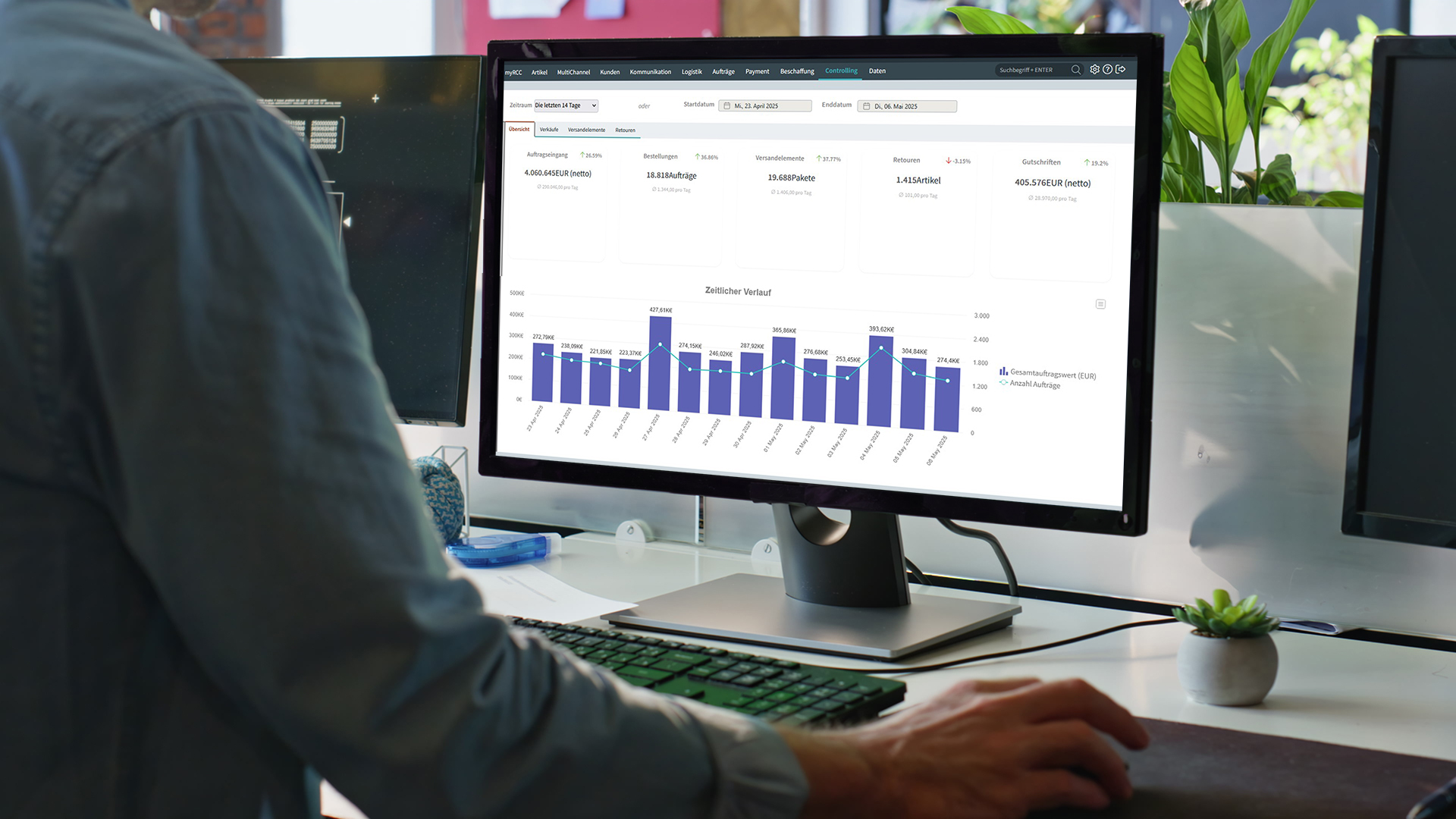
An Order Management System (OMS) is the best solution for optimal order fulfillment. It allows you to centrally manage, intelligently distribute, and efficiently process orders from all sales channels. Challenges in order fulfillment often arise from increasing order volumes, diverse channels, and high customer expectations. These are accompanied by media breaks, a lack of transparency regarding inventory levels, and increased administrative effort.
REMIRA Order Management Software centralizes the processing of all orders from online stores, retail locations, marketplaces, and other sales channels. The solution checks availability in real time and automatically forwards orders to the optimal fulfillment location, taking into account factors such as geographic proximity, available inventory, delivery times, and split orders.
With order management software, retailers benefit from:
Order management software must centrally consolidate all relevant inventory and order data, make it available in real time, and provide it transparently to all departments involved. This includes not only item numbers, prices, currencies, inventory levels, and order numbers, but also information on delivery times, reservations, returns, partial shipments, and cross-channel orders.
A powerful OMS links all relevant data, supports automatic checks and approvals, and ensures that every order can be seamlessly tracked from receipt to delivery. This enables your teams to make informed decisions, avoid booking errors, and lay the groundwork for reliable, fast, and customer-focused order fulfillment—across all sales channels.
An OMS should offer the following features:

IBP and S&OP
Forecasting
Replenishment
Stocktaking
Omnichannel Commerce
Supplier Collaboration
Order Management

IBP and S&OP
Forecasting
Replenishemnt
Stocktaking
Omnichannel Commerce
Supplier Management
Order Management
![]()
IBP and S&OP
Forecast
Replenishment
Stocktaking
Omnichannel Commerce
Supplier Collaboration
Order Management
IBP and S&OP
Forecast
Replenishment
Stocktaking
Omnichannel Commerce
Supplier Collaboration
Order Management

Order management encompasses all activities related to the administration, organization, and fulfillment of customer orders. The scope of order management ranges from receiving the order, through warehousing and shipping the goods, to invoicing and processing returns. Due to the complexity of order processing, which requires many individual steps, many companies now use a specialized order management system.
An Order Management System (OMS) is a digital toolkit that enables companies to optimally manage all ordering and sales processes. This order management software automates and coordinates all aspects of the ordering process—from the receipt of an order to delivery to the customer. An OMS typically integrates with other systems such as e-commerce platforms, warehouse management systems, and accounting software to ensure a smooth workflow.
A well-functioning Order Management System ensures fast, seamless deliveries, leading to high customer satisfaction and increased revenue. Only with such a system can post-checkout processes run optimally. The system also updates inventory in real time, preventing products from suddenly appearing as out of stock in the shopping cart. Additionally, order status updates can be automatically sent to customers.
An order management system manages all data related to products, inventory levels, availability, and delivery times, as well as customer numbers and customer data. The order management system manages all this data, consolidates it, and analyzes it as needed.
While an ERP system primarily manages internal business processes such as accounting, purchasing, or human resources, order management software is specifically focused on customer-oriented, cross-channel order processing. It intelligently manages orders from various sales channels, checks availability in real time, coordinates fulfillment routes, and ensures smooth communication with customers.
When selecting a suitable order management system, attention should be paid to the efficient and seamless integration of the software into the existing IT infrastructure and the existing ERP system. The ability to connect to a platform should also be available. The software provider must also offer training and ensure regular software updates.
An order management system offers standardized interfaces (APIs) to common ERP systems (e.g., SAP, Microsoft Dynamics), warehouse management systems (WMS), point-of-sale systems (POS), and e-commerce platforms. Integration is modular, allowing existing IT structures to continue being used and gradually expanded. This reduces project costs and ensures a fast time-to-value.
Within the framework of REMIRA’s standard processes and standard interfaces, the OMS can be implemented in about six weeks. However, there are usually established special processes or specific interfaces that must be taken into account during the project phase. For this reason, implementation typically takes between three and six months.
When implementing the REMIRA Order Management System, a revenue target of over three million should be set so that the initial investment pays for itself within a reasonable timeframe. There is no upper limit on transaction volume. This is due to the intelligent software architecture and the scalable cloud strategy.
An OMS connects all channels in real time and enables services such as Click & Collect, Ship-from-Store, or cross-channel returns. This creates seamless customer journeys without media breaks.
An OMS is particularly useful for retailers with multiple sales channels, a store network, or complex fulfillment structures who wish to centrally manage orders.
.jpeg)
We would be happy to show you free of charge and without obligation what our software solutions can do, which solution best suits your company and answer all your questions. We look forward to getting to know you and your company!