Omnichannel Commerce Software

All touchpoints of the customer journey at a glance with our software solutions: Sell where people buy. Without media disruption. With a single source of truth. Online and in stationary retail.

Must-have features for omnichannel commerce software

For omnichannel commerce software to work, numerous technical processes must be intertwined in the background. These processes form the backbone of any successful omnichannel initiative by ensuring a solid and integrated technical infrastructure that minimizes errors and communication breaks while significantly reducing manual effort.

Such infrastructure enables companies to provide a consistent and seamless customer experience across all channels, which is essential in today's digital landscape. To achieve this, companies need to invest in technology that enables efficient data integration and management so that information can be shared in real time between the different channels. This includes powerful CRM systems, advanced analytics tools, digital POS systems and robust e-commerce platforms that work together to create a unified picture of the customer. It also requires an agile and scalable IT infrastructure that can quickly adapt to changing market conditions and customer needs.

Only through the close integration of these technical processes can companies create a true omnichannel experience that not only increases customer satisfaction and loyalty, but also opens up new business opportunities.

  • Control of third-party suppliers, shipping service providers and payment service providers. A high level of interface expertise (API, EDI, XML, CSV) is required here.
  • Integration of different sales channels, such as online store, app, marketplace and social media. These have different demands on integration, preparation of product master data, return management, payment, etc.
  • Continuous updates of all stock levels on all sales channels
  • Processing of different payment methods including partial payments, automated processes for handling credit notes
  • Management of shipping options, e.g. shipping from the main warehouse, via drop shippers or external logistics providers, ship from store or click & collect
  • Enabling various return options such as postal shipping or return to the store
  • Integration of or data exchange with inventory systems such as ERP, financial accounting, PIM, logistics and CRM that are not designed for e-commerce processes
  • Answering customer inquiries and creating tickets across all sales channels and dispatch warehouses

Successful omnichannel management with our solutions

POS check-out

REMIRA POS check-out optimizes and accelerates checkout processes. All information is updated in real time across all checkouts and locations. In addition, the system enables detailed analysis of all checkout transactions, providing insights into the purchasing behavior of your customers and the performance of the products. This data is essential to make informed business decisions and continuously optimize sales strategies.


REMIRA POS SHOP 2

   Learn more   

RETAIL - Merchandise Management

Our merchandise management software enables the optimal management of your stores and is the basis for your omnichannel commerce process. Regardless of whether you are a large chain or a small business with two stores: We deliver the right solution and thus provide support in sales, purchasing, controlling and merchandise management. This allows you to work efficiently and focus entirely on your customers.


Mitarbeiterin in einer Filiale mit Tablet vor Kleiderständer @bernardbodo_unbearbeitet

   Learn more   

Order Management

Manage order processing efficiently: In the fast-moving world of e-commerce, customers expect high availability and fast deliveries. Companies are best supported by an order management system that ensures that orders are processed efficiently and quickly, business processes are improved and customer satisfaction is increased.
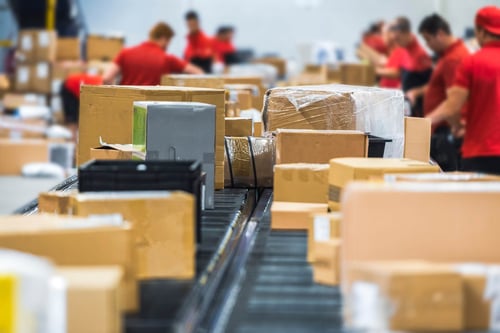

Order Management Pakete Warenband @valdisskudre - stock.adobe.com

   Learn more   

Mobile Store Management Software

With the INSTORE App, you can implement omnichannel, mobile checkout and inventory directly on the shop floor. As a digital assistant in the store, the all-in-one tool quickly becomes irreplaceable for staff, as it combines checkout, omnichannel functions and store management in one system — both in the back office and on the shop floor. Stock transfers or shipping can also be initiated directly from the application.
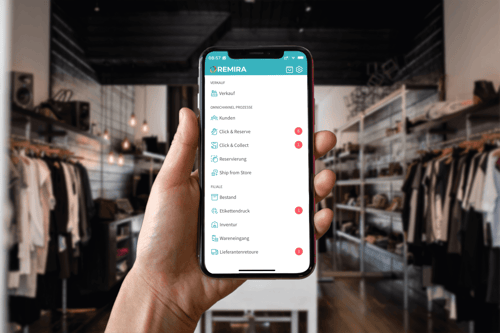

REMIRA-InstoreApp_neu-1

   Learn more   

PAYMENT Services

A payment solution can be this simple, fast and transparent: With REMIRA PAYMENT, you get an integrated solution that maps stationary card payment traffic at the point of sale and in online retail. In addition to all common payment methods, payment providers such as PayPal, Klarna and other providers can also be integrated. With PAYMENT, retailers can combine the service for checkouts, stationary payments and eCommerce payment transactions.


PAYMENT Bezahlvorgang POS @jackfrog - stock.adobe.com

   Learn more   

Successful omnichannel users

Omnichannel commerce software solutions with a special focus on the following industries

Shopping cart retail Retail@monticellllo - stock.adobe.com


Retail

Software for the retail industry:

IBP and S&OP
Forecasting
Replenishment
Stocktaking
Omnichannel Commerce
Supplier Collaboration
Order Management

Employee in warehouse wholesale Warehouse dark @pressmaster - stock.adobe.com


Wholesale

Software for the wholesale industry:

IBP and S&OP
Forecasting
Replenishemnt
Stocktaking
Omnichannel Commerce
Supplier Management
Order Management

Sofa Furniture Deco dark@FollowTheFlow - stock.adobe.com


Furniture &
Decoration

Software for furniture & decoration:
Forecast
Replenishment
Stocktaking
Onmichannel Commerce
Order Management

Couple in the DIY store DIY dark@Nomad_Soul - stock.adobe.com


Building materials &
DIY

Software for building materials & DIY:
Forecast
Replenishment
Stocktaking
Omnichannel Commerce
Supplier Collaboration
Order Management

Fashion clothes clothes rack dark @beeboys - stock.adobe.com

Fashion &
Shoes

Software for fashion & shoes:
S&OP
Omnichannel Commerce
Stocktaking
Order Management
Tennis Tennis racket Sport dark @ivanko80 - stock.adobe.com


Sports &
Games

Software for sports & games:
S&OP
Sales Forecast
Procurement
Inventory
Omnichannel Commerce
Supplier Management
Order Management
Elektronik @Ievgen Tytarenko - stock.adobe.com


Electronics

Software for electronics:

IBP and S&OP
Forecast
Replenishment
Stocktaking
Omnichannel Commerce
Supplier Collaboration
Order Management

Frau mit Laptop auf Veranda Lifestyle black @olezzo - stock.adobe.com


Lifestyle

Software for the lifestyle industry:

IBP and S&OP
Forecast
Replenishment
Stocktaking
Omnichannel Commerce
Supplier Collaboration
Order Management

What our satisfied customers say

FAQ Omnichannel Commerce Software

Omnichannel commerce software connects all sales channels—online, brick-and-mortar, mobile, and marketplaces—to create a seamless shopping experience for all customers. The software synchronizes inventory, orders, prices, and customer data across all channels, thereby providing a unified view of the customer. The goal is to ensure consistent availability, service, and brand perception across all touchpoints.

Omnichannel software includes, among other things, centralized customer, inventory, and order management; click-and-collect; ship-from-store; cross-channel returns processing; price and promotion management; customer account synchronization; marketplace connectivity; and integration with POS, ERP, and shop systems.

Digital store management, Endless Aisle, in-store checkout, and stocktaking are also specialized features of omnichannel software; additionally, integration with customer loyalty cards and loyalty systems should be possible.

A key reason for shopping in brick-and-mortar stores is the ability to view and try out products while receiving expert advice. Omnichannel software supports in-store consultations, provides information on inventory, enables direct checkout without waiting in line, or allows items to be shipped home—for example, in a different color.

Additional benefits of omnichannel software in brick-and-mortar retail include interactive information touchpoints in the store, mobile store management to support staff and optimize personalized customer engagement, as well as digital receipts. The key to success here is cross-channel customer management (CRM system).

Yes, in the REMIRA Omnichannel Software, all inventory can be viewed at any time. In the store management app, merchandise can even be requested from other locations, and customers can be automatically notified upon delivery.

Through centralized data management and real-time synchronization, omnichannel commerce software connects all sales channels: inventory, prices, and customer data are up-to-date everywhere—in the web shop, at the checkout, and in the warehouse.

This allows online orders to be shipped from the store or returns to be processed across stores without system disruptions, and customers can switch between different channels as they wish.

Yes, appropriate omnichannel software offers central marketplace integration (e.g., Amazon, Zalando, eBay, etc.). This allows products, inventory, prices, and orders to be managed directly from the omnichannel solution. The retailer maintains an overview and avoids overselling or inconsistencies across different sales channels.

The REMIRA Omnichannel Software is suitable for retailers of any size. For companies with up to 10 stores, there is also a special SME solution available in the cloud.

Modern omnichannel software offers open interfaces (APIs) and standard connectors for common systems such as SAP, Microsoft Dynamics, Shopify, Shopware, or standard POS systems. This allows the solution to be integrated into the existing IT landscape quickly and without the need for complex system changes.

Thanks to modular architecture, best-practice templates, and preconfigured interfaces, a go-live is often possible within a few weeks. The scope and duration depend on the system landscape and the desired features—many retailers start gradually and expand the solution step by step.

For omnichannel commerce to work, numerous processes must mesh together in the background: An integrated infrastructure prevents errors and communication breakdowns and reduces manual effort. The following processes, among others, must be taken into account:

  • Management of drop-shippers, shipping service providers, and payment service providers. This requires a high level of interface expertise (API, EDI, XML, CSV).
  • Integration of various sales channels, such as online stores, apps, retail media, marketplaces, and social media. These place different demands on integration, product master data processing, returns management, payment, etc.
  • Continuous updating of all inventory levels across all sales channels
  • Processing of various payment methods, including installment payments, and automated processes for processing credit notes
  • Management of shipping options, e.g., shipping from the main warehouse, via third-party suppliers or external logistics providers, Ship from Store, or Click & Collect
  • Enabling various return options such as mail-in returns or in-store returns
  • Integration with or data exchange between legacy systems such as ERP, financial accounting, PIM, logistics, and CRM that are not designed for e-commerce processes
  • Responding to customer inquiries and creating tickets across all sales channels and fulfillment warehouses

The goal of creating a seamless customer journey presents retailers and brands with new challenges. A single channel for communicating with customers is no longer sufficient. The customer-centric approach places the customer at the center of all initiatives. This makes it essential for companies to offer their customers multiple touchpoints so they can be wherever their customers are.

The resulting volumes of data must be managed effectively and automated. If companies ignore this shift, they run the risk of losing visibility and competitiveness. The strategy must be to engage customers across all channels, accompany them, and thereby offer them a seamless shopping experience.

An omnichannel solution helps retailers and brands ensure and continuously optimize this cross-channel data communication. However, this requires the development and maintenance of numerous technical processes in the background:

  • Management of partners such as drop-shippers, payment service providers, or shipping carriers
  • Real-time inventory levels both online and offline
  • Various return options
  • Order management for online and offline orders
  • Routing to the correct warehouse based on various criteria (geography, best availability, split orders, etc.)
  • Back-end systems (ERP, PIM, logistics, and CRM) must be integrated.
  • Customer service and support must function flawlessly across all channels.
Colleagues in conversation Business Meeting @peopleimages.com - stock.adobe.com (1)

Curious about our omnichannel commerce software solution?

We would be happy to show you free of charge and without obligation what our software solutions can do, which solution best suits your company and answer all your questions. We look forward to getting to know you and your company!